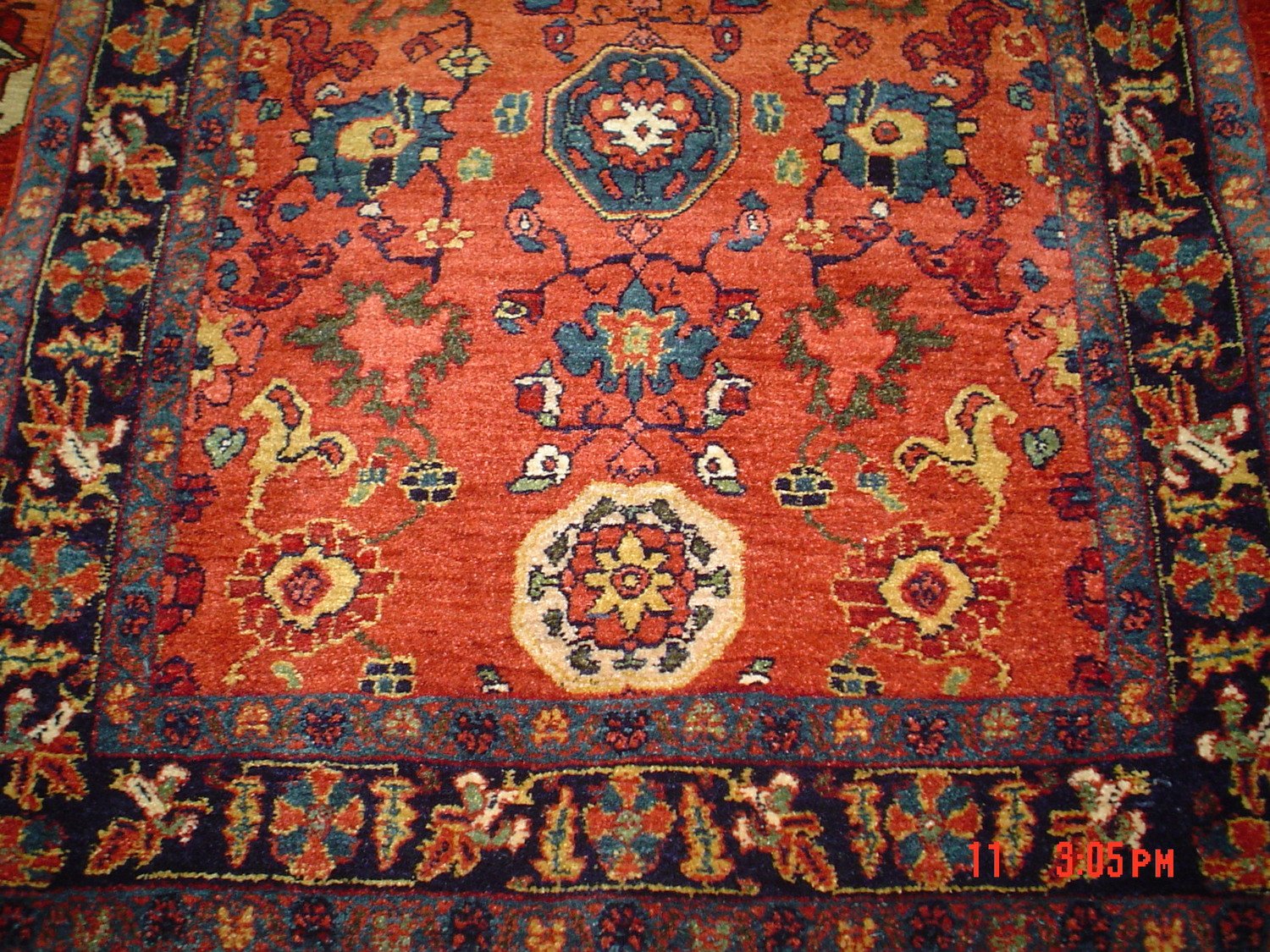
Have a look at my rug gallery offering beautiful Persian and Afghan rugs woven with hand-spun, vegetable dyed wool in antique and modern designs. 707-823-3355
Oriental Rug Definitions by Penny Krieger ©2005-2024
ABRASH: This is the variegated quality in new rugs that are woven with hand-spun wool and vegetable dyes when the wool is dyed at different depths of the same color. It often absorbs the dyes at varying degrees depending on the dying process and the wool used.
In older rugs, ABRASH is color variegation stemming from different dye batches used on one rug. In old or antique pieces the colors may have all been very even when new but over time, mellowed at different rates or faded as the case may be.
AFGHAN WAR RUG: A rug depicting helicopters, planes, tanks, pistols, grenades, AK- 47 rifles, rocket launchers, and sometimes village scenes or maps of Afghanistan, first noted after the Soviet invasion of Afghanistan in 1979.
These rugs were initially rejected by American dealers as they did not fit into any known reference point. In the tradition of incorporating living events into art, the Afghan War Rug has now found a dedicated following and been elevated to collectible status within certain Oriental rug circles. Afghan weavers are continuing to create new and interesting Afghan War Rugs with some recent renditions chronicling the events of 911 and the last decade as you can see in the above photo.
AKSTAFA or AKSTAFA PEACOCK DESIGN: A tribal rug design depicting a stick figure bird with lustrous long tail feathers. Currently found on new rugs with Caucasian-based motifs (Kazaks) or antique pieces from the Caucasus or Turkey.
ANTIQUE ORIENTAL RUG: A rug woven 100 or more years ago. Regretfully, some rug dealers use this term loosely. Prior to 1860, all handwoven rugs were created with vegetable dyes, sometimes called natural dyes or plant-based dyes. Some of the gorgeous colors created in the past have never again been duplicated and most of the rugs woven before this time were characteristic of the traditions of the location where they were woven or the tribal affiliation of the weavers. Dye masters of the past were highly respected and their formulas for achieving these wonderful colors were closely guarded and rarely shared! See my blog post on “What Makes an Oriental Rug Valuable”.
BID MAJNUN: A classic, antique Persian Bijar design that features Cypress and Willow Trees. It is very similar to the more broad Tree of Life design but specific in origin to weavers from the Kurdish town of Bijar, Iran.
BIJAR: A town in NW Iran (including the surrounding villages) where the rugs of this name are produced. Bijar rugs are woven by Kurdish weavers with incredible originality and variation in the designs created. Bijar rugs are renowned for their durability and have been nicknamed, "The iron rugs of Iran". One of the most famous BIJAR designs is the GARRUS design. Sometimes spelled: Bidjar.
BOTEH: The small teardrop design that you see in Paisley. There are many arguments among rug scholars as to the significance of this drawing. Some say flame, pear, leaf, pine cone, and this list goes on. There are numerous renditions of this symbol found in rugs of antiquity; some geometric that are difficult to recognize unless one is familiar with the basic form. The flame gets my vote from the ancient Zoroastrians that revered and respected fire.
BAF: A suffix meaning "woven by".
CARPET: A large or oversized rug, usually not less than 9' x 12'.
CARTOON: A picture of the rug to be woven (on graph paper) indicating the exact placement of each knot to be tied and in what colors to create the design of the rug.
CHINESE RUG: An Oriental rug woven in China. Sometimes the term "Chino" will be on the label of a rug produced in China. An example of this might be: Chino-Tabriz; this would be a Tabriz design rug woven in China.
DECORATIVE: Denotes beauty in a rug that is not necessarily an antique or collectible piece. Example: This rug is highly decorative.
DOBAG (Doğal Boya Araştırma ve Geliştirme Projesi): Natural Dye Research and Development Project, Turkey.
ELEPHANT'S FOOT: Additional name for a large gul on Turkoman rugs, most often seen in Ersari Turkoman rugs. Ersari Turkoman: One of the more prolific weaving groups of the Turkomans now settled in northern Afghanistan and Turkmenistan. The most well-known Ersari weaving design is of large octagons (called guls) set in rows on a red background.
FINE QUALITY or finely woven: A term used to denote a high knot count in hand-woven rugs.
FOUNDATION of the rug: The warps and wefts.
GABBEH RUG: The word Gabbeh means unfinished or unclipped and originally referred to simple, whimsical rugs Persian weavers kept for themselves and sometimes used for sleeping. Originally Gabbehs had long pile and up to 5 or 6 rows of wefts. With this many wefts, the rug could be produced very quickly. See my article, “What is a Gabbeh?”
GHANZI: City in E Afghanistan, SW of Kabul, known for producing silky, beautiful wool.
GUL: This term come from a Persian word meaning flower. It is a geometric design element, octagon in shape, usually set in rows and associated with Turkoman rugs.
HERIZ, HEREZ: A town in the Azerbaijan Province of Iran where these rugs were originally woven. The most frequent Herez rug layout has a geometric based medallion design, almost square in nature, which is again reflected in each corner of the field with a traditional palmette border, encased by minor borders in more detailed designs. The colors most often seen are reds, blues, ivory with small increments of gold. The look of the Heriz rug is tribal in nature as these rugs were originally woven with hand-spun wool and vegetable dyes. The more finely woven antique pieces, often in lighter tones have been designated SERAPI RUGS. New rugs with the SERAPI designation would be reproductions of antique pieces.
INTENTIONAL MISTAKE: With the concept that only God or the Supreme Being possesses the capability of perfection in creativity, Persian weavers have been known to create an intentional mistake as a standard action so as not to offend their Creator. This is still in practice today but much more prevalent in older or antique rugs and carpets.
KHAMSEH: 1) Persian tribal affiliation, Fars Province, SW Iran. Confederation of 5 nomadic tribes that originally came together to fight the Qashqai. [The root of this word comes from an Arabic word meaning 5.]
[Current production of vegetable-dyed tribal rugs from this area of Iran are woven with fantastic hand-spun Persian wool in traditional designs.] Please see my galleries with the above-named rugs.
KILIM or KELIM: A flat woven rug composed only of warps and wefts with no knots being tied.
KPSI: Knots per square inch.
MAMLUK EMPIRE: Egyptian Military Class in power from 1250 to 1517.
MAMLUK RUG DESIGNS & HISTORY: I do not very often link to another Oriental Rug retailer's website but this article is excellent so I am offering a link here. If you are interested in learning who the weavers were in this time frame and location read on! This article is fascinating! Antique Mamluk Rug History
MAMLUK RUGS: The Mamluk Rugs offered at my gallery are woven in Afghanistan with hand-spun wool and dyes made from natural sources. The more finely woven pieces are 270 kpsi.
MEDALLION: The central design motif found precisely in the middle of the rug. It can be round, diamond-shaped, or square but each weaving group has its own characteristic designs. The word itself comes from a 17th Century Italian word meaning large metal.
OLD: A positive term denoting some age but not an antique.
ON APPROVAL: If a client really loves a rug and has any doubt or hesitation about how it will work in their home, they can secure payment with my gallery (as in a credit card or a check) and take the rug home to ensure it works perfectly. This is called taking the rug "on approval". Sometimes those purchasing rugs have numerous furnishings and other rugs already in place and they cannot bring all these items to my shop nor can one predict 100% how the lighting will affect the look of the prospective rug in their home environment. This is mentioned in my article, "How to Buy an Oriental Rug".
PAZYRYK CARPET: The oldest complete known rug discovered in 1949. Over 2500 years old, it was found at the burial site of a Prince in the Pazyryk Valley of the Altai Mountains in Siberia, frozen in permafrost.
PERSIAN RUG: A hand woven rug from Iran or from the former Persian Empire. See my article, “What is the Difference Between an Oriental Rug and a Persian Rug?”
PILE: The actual fabric of the rug. The pile is composed of the threads emanating from the knots tied around the two warps at the base of the rug. The pile shows the design and IS what you are walking on when you travel across your rug! The pile can be trimmed quite short or left long or anything in between. On tightly woven rugs it will be cut shorter so as to see the details of the design and colors.
PROGRAMMED RUGS: An Oriental Rug designed in detail, usually on a piece of graph paper with all colors predetermined that is reproduced in numerous sizes. Many programmed rugs are woven with machine-spun wool and use chemical dyes (Swiss and German chromium-based dyes) as opposed to plant-based or vegetable dyes and hand-spun wool.
QASHQAI: A tribal confederacy generally associated with the Fars province in Iran. According to one reference, the majority of Qashqai were decedents of Turkish peoples and still speak a Turkish language. Formerly nomadic, many Qashqai are now settled in small villages in southwest Iran. Their antique rugs are highly sought after and their new vegetable dyed rugs, including Gabbeh rugs, are superlative. Here is a recent article I wrote with more info on Qashqai rugs.
SERAPI: See HERIZ.
SULTANABAD: Former name of the city of Arak in West Central Iran. Sultanabad and the surrounding area was known for abundant workshop production in the late 19th and early 20th Century. The most famous producer in this location was the Ziegler firm which produced Ziegler Mahals. The most easily recognizable Sultanabad design is an overall floral motif (no medallion) with a traditional Persian border.
TABRIZ: 1) A city in Iran known for its finely woven workshop rugs with intricate, detailed designs, often using both wool and silk in the pile. 2) An Oriental rug woven in Tabriz.
TRIBAL RUG: A rug woven by nomadic or pastoral people based on traditional motifs woven with hand-spun wool. Tribal rugs were originally woven on wooden looms set up on the ground to be dismantled and reassembled while traveling. Normally a tribal rug will have a lower knot count and a geometric pattern versus the tightly woven symmetrical floral styles usually found in rugs produced in the larger cities. Older or antique tribal pieces will most often be woven on a wool foundation with plant-based dyes.
Tribal pieces also include textiles woven to be used in daily life. These would be any pieces used inside or outside of nomadic dwellings or as animal trappings; functional or decorative. A few examples are: tent bands, saddle bags, salt bags, etc. These are referred to as Oriental rug trappings.
VILLAGE RUG: Rugs woven in villages settled by former nomadic or pastoral tribal peoples. Village rugs and Tribal rugs would be included in one group versus city rugs or workshop rugs at the other end of the spectrum.
WARP: The vertical threads that are set up on a loom as the first step in creating a hand-woven rug. If the loom is not upright but on the ground, these threads run top to bottom or lengthwise. The knots are tied around the two warps so the warp is part of the foundation of the rug.
WEFT: Threads that are inserted running horizontally (side to side) after a row of knots have been tied. These wefts work to hold the knots in place. A rug can have one, two, three, or more wefts depending on the type of rug or location where it is being woven.
WOOF: An older term for weft. The "warp and woof" is sometimes used in literature to denote the heart of something, it’s inside workings, structure, or significance.
WORKSHOP RUG: See "CITY RUG."
Penny Krieger is the owner of Paradise Oriental Rugs, Inc., located in Walla Walla, WA. Her gallery specializes in tribal rugs and carpets woven with hand-spun wool and plant-based dyes with a strong emphasis on Persian rugs and tribal designs woven in Afghanistan. She is now selling rugs on an appointment basis. For more info please have a look at her website: https://www.paradiseorientalrugs.com Phone: 707-823-3355